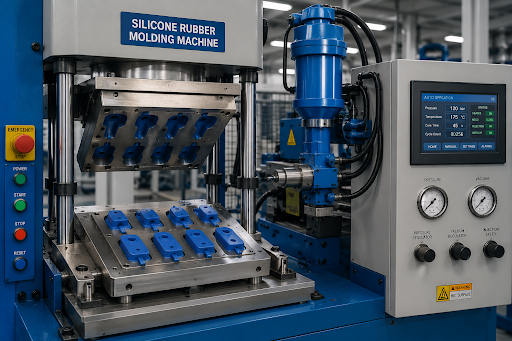
Liquid silicone rubber (LSR) earns its place in high-speed precision molding because of a specific set of material properties: shear-thinning flow, fast platinum cure kinetics, mechanical resilience, and stability across an extreme temperature range. Unlike thermoplastics, LSR cures rather than cools, so the material chemistry, not just the machine settings, decides whether a molding program succeeds.
This guide explains each core property of LSR silicone material, the numbers behind it, and how it translates into processing decisions and end-use performance for engineers and buyers.
Key Takeaways
- LSR is a highly durable and temperature-resistant material.
- The key material properties are viscosity, mechanical strength, biocompatibility, etc.
- This material has extensive applications in the automotive and healthcare industries.
- Shrinkage can be controlled via high-cavity pressure.
Why Material Properties Matter in LSR Processing
In thermoplastic molding, a polymer is melted, shaped, and cooled back into the same material. In the LSR injection molding process, two reactive liquid components are mixed and permanently crosslinked inside a heated mold. The material entering the press and the material leaving it are chemically different. That is why every processing parameter, from injection pressure to cycle time to mold venting, is dictated by the material properties described below. For the full production sequence from tooling through inspection, see our complete guide to the LSR molding process.
LSR Material Properties at a Glance
The table below summarizes typical values for standard LSR grades. Exact figures vary by supplier and formulation, so always confirm against the material datasheet for your specific grade.
| Property | Typical Value (grade dependent) | Why It Matters |
| Uncured Viscosity | Shear-thinning; flows readily under injection shear | Fills thin walls and micro features at low pressure |
| Shore A Hardness | 5 to 80 (harder custom grades available) | Tunable softness from soft-touch parts to firm gaskets |
| Tensile Strength | 800-1,500 psi (5.5-10.3 MPa) | Structural integrity of thin sections under load |
| Elongation at Break | Over 300% | Parts stretch during demolding and flex in service |
| Tear Strength | Roughly 15-45 kN/m; high-tear grades available | Survives demolding of undercuts without nicking |
| Compression Set | Below 20% | Seals and gaskets hold seating force over time |
| Service Temperature | -65°F to +392°F (-54°C to +200°C) | Engine bays, sterilization cycles, cold-chain use |
| Dielectric Strength | Around 20 kV/mm | Reliable insulation for electronics and connectors |
| Density | Approximately 1.1-1.15 g/cm³ | Lightweight parts; accurate shot-weight costing |
| Cure Shrinkage | 1-5% | Scaled into cavity dimensions during mold design |
Table 1: LSR Material Properties
The Core Material Properties of LSR
The main material properties include:
Viscosity and Flow Behavior
The viscosity level of LSR (ranging from 50,000 to 500,000 centipoise) maintains a stable range before cure. This exhibits shear-thinning (pseudoplasticity), allowing it to flow into complex geometries. Because of its low viscosity, the material easily flows into complex and intricate thin-walled geometries. Viscosity level can be high depending on formulation, molecular weight, and the considered application.
Higher viscosity leads to reduced flash risk at parting lines but might require higher injection pressure. To prevent flash, precise mold venting is required. This material property of LSR contributes to precise micro parts.
Mechanical Strength
The LSR injection molding process manufactures durable components that possess high tensile strength and flexibility. This contributes to maintaining the structural integrity of the finished component. High elongation is vital in manufacturing as it indicates high material ductility, thereby allowing materials to stretch, bend, and deform under stress.
The tensile strength of the material is around 800–1,500 psi. Because of the high tensile strength in the liquid silicone rubber injection molding process, the material obtains a high elasticity level, and it easily withstands extreme temperature ranges. This makes the material highly resistant to degradation from chemical exposure and UV light.
Exceptional Biocompatibility
The superior biocompatibility of liquid silicone rubber processing makes the material safe for long-term contact with human tissue. LSR is FDA approved, and it meets ISO 10993 biocompatibility standards. LSR materials possess excellent antimicrobial properties, and they do not stain other materials.
Molded LSR parts withstand rigorous sterilization methods, like steam, gamma radiation, and ethylene oxide. Because it remains stable when in contact with bodily fluids, it is highly biocompatible and ideal for surgical instruments. The tasteless and odorless nature of LSR material makes it a key consideration in healthcare industries.
Temperature Resilience
Without melting or embrittling, LSR materials can deal with extreme temperatures. Because the material remains elastic even at cryogenic temperatures, a swift manufacturing process is ensured. This property makes the material a choice in high-heat engines.
Compared to thermoplastics, LSR materials possess better resistance to high temperatures. This makes it a better way to combat autoclaving. Because of the temperature resilience, cured parts maintain high structural integrity and flexibility.
Chemical Resistance
The liquid silicone rubber molding process comes with a standout chemical resistance, which makes it a perfect choice for harsh and sanitary environments. Because of the thermoset, molded liquid silicone rubber is resistant to oils, water, and several acids.
Despite being highly inert, LSR has a limited resistance to certain chemicals. These include:
- Aromatic hydrocarbons (benzene or toluene)
- Concentrated bases
- Several solvents (acetone or chloroform)
Electrical Insulation
The LSR process of molding has an excellent electrical resistivity and dielectric strength. This allows the material to retain its properties even in harsh environments. The LSR overmolding process is done in a sealed cavity, often over electronics, where the goal is to ensure precise insulation and protection from electrical faults.
LSR retains insulating properties in temperatures ranging from -40°C to 200°C. This makes the material a perfect choice for automotive and transformer applications. As the LSR molding process acts as a powerful insulator, it resists voltage breakdown.
How LSR Material Properties Map to Industry Applications
Each property above pulls a different industry toward LSR. The table summarizes the connection, and the sections below add detail.
Key Material Properties and Their Impact
The material properties of LSR derive its adoption across diverse sectors. Here is how these properties can be impactful across industries:
| Property | Industry Impact |
| Extreme Temperature Resistance | Automotive Industry |
| Electrical Insulation & Conductive Capability | Electronics |
| Biocompatibiliy & Sterilizability | Healthcare and Pharmaceuticals |
| Weather & Temperature Resistance | Aurospace and Outdoor Equipment |
Table: Properties of LSR and Their Industrial Impact
The Industries Where LSR’s Application is Critical
Based on the impact of LSR’s material properties, here are the industries where the application of LSR has become essential:
Healthcare: LSR is inherently biocompatible, along with having high sterilizability and hypoallergenic properties. This makes the material ideal for surgical instrument grips, respiratory masks, catheters, etc. Konark Silicones ensures ISO-compliant LSR molding to serve California’s robust medical device and biotech sectors.
Automotive: LSR is highly resistant to high or low temperatures. Hence, you can use it in O-rings, electrical connectors, gaskets, etc. This makes liquid silicone rubber processing a consideration in the automotive industry.
Consumer Products: LSR is highly moisture-resistant. Therefore, this material is considered in bottle nipples (baby products), kitchen bakeware, blenders (sealing components in consumer appliances), etc.
Common LSR Processing Challenges and Probable Solutions
Two recurring production issues trace directly back to the material behavior described above. Both are preventable.
Shrinkage
LSR undergoes significant thermal expansion in the hot mold. The shrinkage takes place after the removal of the part, which is followed by cooling down. This is primarily because of the temperature difference. Shrinkage is greater in the direction of material flow than perpendicular to it.
Shrinkage is controlled via mold flow simulation. At Konark Silicones, we ensure mold trial data before production, mold flow simulation during design, and post-cure dimensional verification. This can also be controlled via high-cavity pressure and optimized mold temperature (usually 170°C to 190°C).
Platinum Inhibition
Platinum inhibition refers to a chemical reaction that takes place when the platinum catalyst is deactivated by contaminants. This contributes to a sticky surface at the interface of the material. The fundamental causes are sulfur (found in latex), condensation-cure silicones, amines, etc.
How to combat this? Well, using nitrile gloves instead of latex is a good solution. In addition, using a sealant like shellac for coating surfaces during the LSR injection molding process can be a consideration.
Planning to Obtain an LSR Contract? Choose Konark Silicones
We are a renowned LSR contract manufacturer in California. We cover a range of LSR applications. Visit us and get an expert consultation. Get the best-quality work done.
Frequently Asked Questions (FAQs)
1. What Leads to Tacky Surfaces in LSR Molded Parts?
Platinum inhibition is the primary cause of tacky surfaces in LSR molding. The key aspects are Sulphur, organotin compounds, and amine-cured epoxies. Improper 1:1 mixing of components is also a common cause.
2. How Does LSR Differ From High Consistency Rubber (HCR)?
LSR differs from HCR in handling, processing, and tensile strength. LSR maintains an easy flow while pumping into molds, whereas HCR is a high-consistency, clay-like solid that requires kneading, cutting, and manual handling. LSR is processed via injection molding, but HCR considers compression molding and extrusion. Referring to mechanical strength, HCR generally possesses superior tear strength.
3. How to Control Hardness in LSR?
Hardness in liquid silicone rubber is controlled by choosing specific material grades (ranging from 5 to 90 Shore A). Also, this can be controlled by altering the crosslinking density. Often, silicone resin is considered during the formulation phase to adjust flexibility.
4. Is Post-Curing Necessary in LSR?
This depends on its application. Post-curing is vital for food-grade, medical, and high-precision parts to remove volatile components and ensure stability. Well, this is not necessary for non-sensitive applications.
5. How to Store Silicone Rubber Products?
Silicone rubber products must be stored in a cool and dry place, and away from sunlight. The ideal storage temperature is below 30°C. This helps to maintain the material’s integrity, along with ensuring its longevity.