Silicone Materials

Silicone materials are engineered elastomers that combine thermal stability, chemical inertness, biocompatibility, and mechanical flexibility in a single material platform. Thus, these materials become the preferred choice for molded components across medical, consumer, industrial, and electronics applications. 

Silicone is available in two primary forms used in molding:

Liquid Silicone Rubber (LSR): A low-viscosity material suited to injection molding. 

High Consistency Rubber (HCR): A higher-molecular-weight and higher-viscosity compound primarily used in compression and transfer molding. 

Room Temperature Vulcanizing (RTV) materials, gels, adhesives, dispersions, and caulking compounds also exist within the silicone family. However, they are not commonly used in production molding applications. 

Selecting the right silicone material form, cure system, durometer, and grade is foundational to a successful molding project. At Konark, material selection is part of our engineering process. We work with customers from the prototyping stage to the production stage to identify the material that meets their performance, regulatory, and processing requirements. 

Konark

silicone products manufacturer

Silicone Material Forms

Liquid Silicone Rubber (LSR)

Liquid Silicone Rubber is a two-part, platinum-cured elastomer which is supplied in the form of a pumpable liquid. It is also a low-viscosity liquid that allows it to flow into complex geometries, thin walls, and tight-tolerance features that solid rubber compounds cannot fill as reliably. LSR is the material of choice for high-volume injection molding, cleanroom medical manufacturing, and any application that requires part-to-part consistency across millions of cycles. 

Because LSR uses a platinum cure system, it cures faster while also producing fewer volatile byproducts than peroxide-cured materials. This makes it particularly well-suited for medical and food-contact applications where a major concern is residual volatiles. 

High Consistency Rubber (HCR)

High Consistency Rubber is a higher-molecular-weight silicone compound that comes with a dough-like consistency. It is processed through compression molding, transfer molding, and extrusion. HCR is the traditional form of silicone, and is available across the full durometer range. This material is used in seals, gaskets, tubing, profiles, and custom molded parts where injection molding tooling investment is not justified by volume or part complexity. 

HCR can be cured with either platinum or peroxide cure systems. Peroxide-cured HCR requires post-baking in an oven after molding to remove residual volatiles. This is a mandatory step for medical-grade components. 

Konark

silicone products manufacturer

Cure Systems

The cure mechanism is one of the most important selection criteria for any silicone rubber material. 

Platinum Cure delivers faster cycle times, lower residual volatiles, and better optical clarity than peroxide systems. It is the standard for medical devices, food-contact parts, and any application where volatile byproducts are not acceptable. Platinum cure also supports self-adhesive LSR formulations used in the overmolding process.

Peroxide Cure is a slower-curing option that requires post-baking to drive off any residual volatiles from the curing agent. It remains in use for industrial and general-purpose applications where the post-bake step is not a process constraint. For medical components, post-baking is a crucial step regardless of whatever cure system is used. 

Konark

silicone products manufacturer

Durometer and Hardness

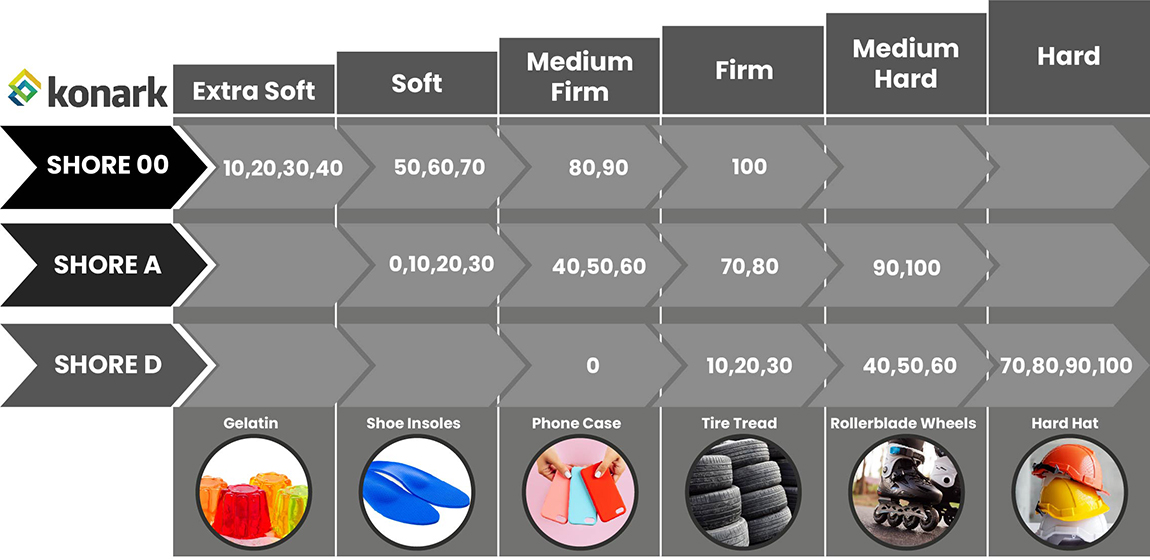
Silicone material hardness is measured on the Shore A scale using a durometer pin gauge. Materials are available from Shore 5A (extremely soft, gel-like, body-conforming) to Shore 80A (approaching a firm, load-bearing, hardness). The Shore A range covers the vast majority of molded silicone applications.

Durometer selection is driven by the functional requirements of the part. Soft durometers are considered in the 10A to 30A range and are used for cushioning body-contact wearables, valve membranes, and vibration damping. Alternatively, mid-range durometers are considered for 40A to 60A, and are applicable for seals, gaskets, grips, and diaphragms. Meanwhile, firmer formulations from 60A to 80A are used in cases that require dimensional stability under load, structural support, or resistance to extrusion under pressure.

Konark

silicone products manufacturer

Silicone Material Grades

Silicone materials are formulated as general-purpose compounds or as specialist grades which are engineered specifically to deliver key performance properties. Konark works with the following grades as per the application requirements:

General or Multipurpose

Available from Shore 5A to 80A. This grade of silicone is best suited for seals, gaskets, valves, diaphragms, consumer goods, and consumer electronics. Here, no specialized property is required beyond the baseline silicone performance.

Fluorosilicone (F-LSR)

Provides significantly improved resistance to fuels, oil, and solvents, especially when compared to standard silicone. It is applied in automotive fuel system seals, aerospace applications, and industrial environments with hydrocarbon exposure. 

Low Coefficient of Friction (Low COF)

Reduces surface drag without the need for secondary lubrication. Used in catheter components, implantable tubing, and in any application where silicone surfaces contact each other or other materials in motion. 

High Tear Resistance

Formulated to resist crack propagation under tensile and flexing loads. Rated in accordance with ASTM D 624B. This is especially applicable in the cases of thin-walled seals, surgical gloves, and parts that experience repeated stretching. 

Low Compression Set

Engineered to recover to its original height after a period of sustained compression. It is critical for seals and gaskets that must maintain a reliable sealing force over the life of the product.

Self-Adhesive

Bonds directly to thermoplastics such as Nylon, PBT, PET, and PC, without primers or surface treatments. It works as the enabling material for two-shot and insert overmolding in electronics, wearables, and consumer devices. 

Oil Exuding (Oil Bleeding) 

Releases a controlled amount of silicone oil onto the surface over time. Thus, providing built-in lubrication. It is used in electrical and automotive connectors and seals where dry assembly and long-term lubrication are both required. 

Electrically Conductive

Available in 10 ohm-cm, 5 ohm-cm, and 0.1 ohm-cm volume resistivity. Used in EMI/RFI shielding gaskets, keyboard contacts, and grounding applications where electrical conductivity and silicone’s environmental resistance are both needed. 

High Transparency or Optical 

Formulated for maximum light transmission. It is primarily applicable in LED encapsulants, light guides, optics, and any application requiring a clear or near-clear silicone component.

Flame Retardant

Meets applicable flammability standards. That makes it effective for applications in fire safety, electrical enclosures, and aerospace interiors.

High Heat Resistance

Engineered for sustained performance at elevated temperatures above the range of standard silicone. It is used in automotive underhood applications, aerospace components, and industrial processing equipment. 

Konark

silicone products manufacturer

Benefits of Silicone as a Material

Silicone, be it Liquid Silicone Rubber or High Concentration Rubber, is notable as the default material for demanding molded components. Its performance profile covers a combination of properties that no other single elastomer reliably delivers. 

Silicone remains stable and flexible from -60°C to +200°C and above in high-heat grades, without cracking, stiffening, or losing its seal under thermal cycling. Its chemical inertness means it resists oils, solvents, steam sterilization, gamma radiation, and UV exposure. These properties that cause most organic rubber compounds to degrade over time. 

Biocompatibility is another defining characteristic. Properly formulated silicone will meet USP Class VI and ISO 10993 standards for skin-contact, implantable, and fluid-path applications, which makes it the material of choice across medical device manufacturing. Its bio-inert nature also makes it suitable for separating non-biocompatible internal components from the patient contact surface of a device. 

Silicone rubber is also an outstanding electrical insulator. This gives it a natural role in electronics overmolding, connector sealing, and cable protection. Moreover, silicone’s wide durometer range (from near-gel softness to firm structural hardness) within a single material chemistry makes its versatility unique. It becomes a single material platform capable of serving body-conforming wearables and load-bearing industrial seals equally. 

Konark

silicone products manufacturer

Applications and Industries

Silicone materials are used wherever a molded component needs to reliably perform across temperature extremes, chemical exposure, regulatory scrutiny, or human contact. 

Medical devices depend on biocompatible Liquid Silicone Rubber for cardiovascular components, surgical instruments, endoscopic seals, anesthesiology equipment, urological devices, and so on. Platinum-cured LSR’s compatibility with autoclave, gamma, and EtO sterilization makes it practical for both reusable and single-use device categories. 

Electronics and wearables use silicone for overmolding PCBAs and connectors, sealing charging ports and cable junctions, while also producing soft-touch button membranes, and protecting sensors in fitness trackers, smartwatches, and health monitoring devices. Self-adhesive and electrically conductive grades often extend the range of what silicone can achieve in this space. 

Automotive and aerospace applications often include fuel system seals in fluorosilicone, underhood gaskets in high-heat grades, oil-bleeding connector seals, and flame-retardant components for interior and electrical systems. 

Industrial and consumer goods usually rely on general-purpose and low-compression-set grades for valves, diaphragms, gaskets, and food-contact parts where long-service life and chemical resistance are primary requirements.

Konark

silicone products manufacturer

Colors

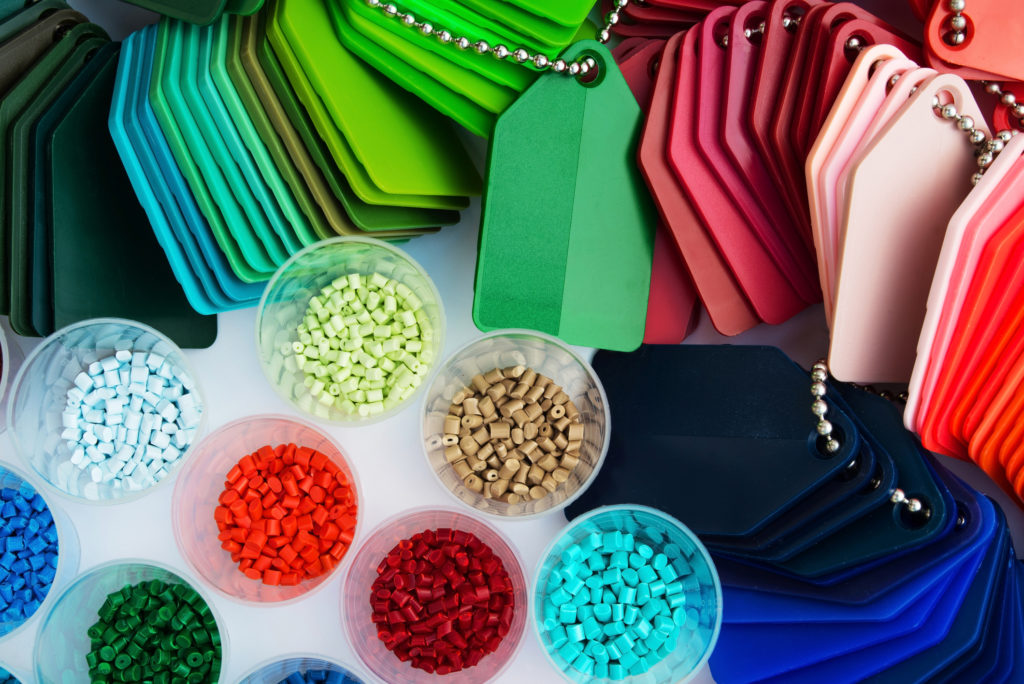
Silicone materials can be pigmented to virtually any color. Konark can help by matching any color from a Pantone number or customer description. Color is a processing variable and not a material change. Thus, color selection does not affect the base physical or regulatory properties of the chosen grade.

Konark

silicone products manufacturer

Why Konark?

At Konark, we pride ourselves on quality. Our goal is to ensure that the first and the millionth silicone parts that we offer are the exact same. Our practice includes the applications of lean manufacturing techniques and Six Sigma quality principles. Continuous improvement is also what drives everything we do. Material selection is an integral part of that process. We do not just mold to a customer’s material call-out without reviewing whether or not it is the correct fit for the application, the process, and the regulatory requirements that are involved.

Contact Konark Silicones today, and one of our silicone material and molding experts will be happy to help you with the identification of the correct material for your project. 

Konark

silicone products manufacturer

Frequently Asked Questions on Silicone Materials

Shore A is the hardness scale used for soft elastomers, which include silicone. A lower Shore A number implies a softer and more flexible material. Alternatively, a higher number implies a firmer and stiffer part. The lowest available Shore A number for silicone is 5A, which is nearly gel-like. Moreover, silicone is available from Shore 5A to Shore 80A. The highest number is firm and resists deformation under load. The correct durometer depends on your intended use of the part, whether it is for cushioning, sealing, gripping, flexing, or supporting a structural load. 

Platinum cure produces fewer residual volatile byproducts, cures faster, and is necessary for most medical, food-contact, and optical applications. Peroxide cure is slower and leaves residual volatiles that must be removed by post-baking in an oven. For medical components, post-baking is a mandatory step, regardless of which system of curing is used. Platinum cure is generally preferred wherever the processing allows it. 

Self-adhesive LSR is the right choice when the substrate is a compatible thermoplastic, be it Nylon, PBT, PET, or PC. Also, the process benefit of eliminating a primer application step outweighs any cost difference in material. Primers remain the better option for substrates that self-adhesive grades do not reliably bond to, or when the maximum bond strength across the full service life of the part is the overriding requirement. Konark’s engineering team will evaluate both options during the design phase. 

Yes. Electrically conductive silicone grades are available in volume resistivities of 10 ohm-cm, 5 ohm-cm, and 0.1 ohm-cm, achieved by loading the base silicone with conductive carbon or metal-based fillers. These materials are used in EMI/RFI shielding gaskets, grounding pads, and keyboard contacts, where electrical conductivity and silicone’s environmental resistance need to coexist in a single part. 

Fluorosilicone (F-LSR) is the standard choice for applications involving sustained exposure to fuels, oils, and hydrocarbon solvents. Standard silicone grades offer reasonable chemical resistance to water, steam, and many polar solvents, but degrade in the presence of aliphatic and aromatic hydrocarbons. If your application involves fuel system exposure or aggressive industrial fluids, fluorosilicone should be specified.

At Konark, manufacturing silicone parts and components is our passion. Silicone rapid prototyping and silicone engineering is what we do best. Our goal is to take our customers from the silicone prototyping phase to high volume production in a robust, efficient and economical process.

Get In Touch
© 2026 KONARK SILICONE TECHNOLOGIES. All Rights Reserved.